Thinning hair,
explained plainly.
Most women lose some density somewhere along the way. It shows up first at the part, then across the crown, and it usually changes how you feel about being photographed long before anybody else notices a thing.
This page is not a sales pitch. It is what Maria would tell you if you sat down in her chair and asked: what is likely going on, when it is worth seeing a doctor instead of a stylist, and what a well-fitted topper genuinely can and cannot do.
What is usually going on
Six common reasons
More than one can be true at the same time, and the first is by far the most common in women.
Hereditary thinning
The most common reason women lose density. It shows as a part that widens over years rather than bald patches, usually across the top and crown, with the hairline staying put.
Gradual, symmetrical, and often familiar from your mother or grandmother.
Telogen effluvium
A shock (childbirth, surgery, a bad illness, a crash diet, a bereavement) pushes a large share of hairs into the shedding phase at once. The shed shows up two to four months after the event, which is why it rarely feels connected to it.
Sudden, alarming handfuls, usually temporary, and it often recovers on its own.
Thyroid and iron
An under- or over-active thyroid and low iron are both common and both well known to affect hair. They are also both simple blood tests.
Often comes with fatigue, temperature sensitivity, or changes in weight.
Hormonal shifts
Perimenopause, menopause, stopping or starting hormonal birth control, and PCOS all change the hormonal balance that hair growth depends on.
Frequently arrives alongside other changes you have already noticed.
Traction
Years of tight ponytails, buns, braids, weaves or badly fitted extensions pull on the follicle. Caught early it recovers; left long enough it does not.
Thinning at the hairline, temples, or wherever the tension sits.
Medication and treatment
A long list of medicines list hair loss as a side effect, and chemotherapy is the best known cause of all.
Timing usually lines up with starting or changing something.
Where a stylist stops
See a doctor, not a hairdresser.
Maria is a stylist, not a physician. She has spent forty-three years looking closely at scalps, so she can often tell you whether a pattern looks like the ordinary hereditary kind, but she cannot diagnose you, and she will say so.
Several of the causes above are found with a simple blood test and treated. That is worth ruling out before you spend money on covering it up.
Book an appointment with your doctor if you notice
- Hair coming out in distinct round patches rather than thinning overall
- A scalp that is sore, burning, itching, scaling or visibly red
- Loss that is sudden and rapid rather than gradual
- Thinning alongside fatigue, weight change, or changes to your periods
- Any loss that started after a new medication
- Thinning in a child or teenager
What a stylist can do
Four things that genuinely help
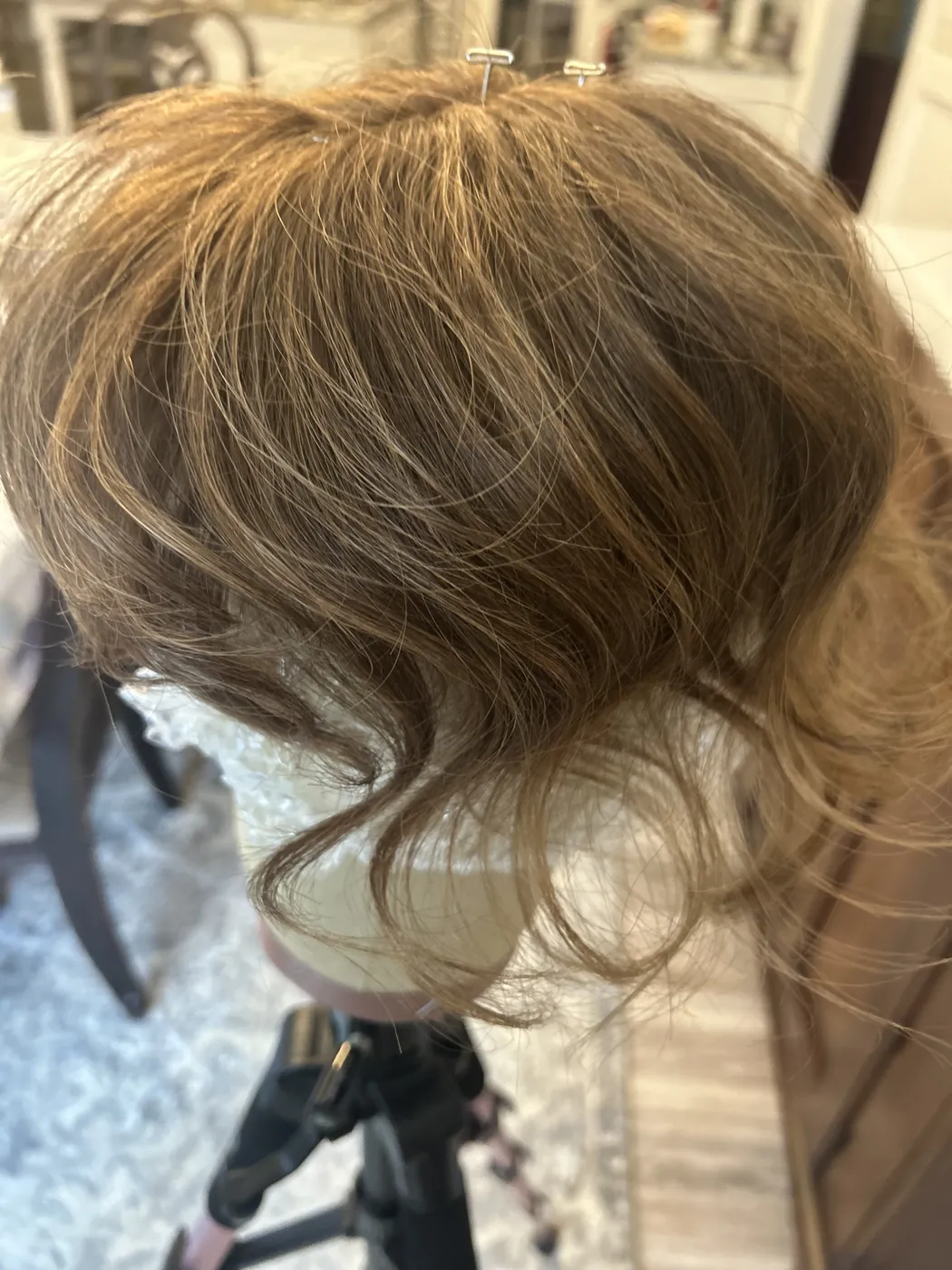
Every piece is colored and cut before it is ever fitted.
A topper, fitted to the area you have actually lost
A small hairpiece that clips at the part or crown and adds density exactly where it has gone, while your own hair stays out and visible around it. Maria colors every piece to your hair and cuts it into your own before you leave, which is the whole difference between one that reads as a hairpiece and one that does not.
A cut that works with the density you have
Length pulls hair flat and makes thinness more obvious. Weight removed in the right places, and left in others, can make the same head of hair look considerably fuller. This costs nothing extra and it is the first thing she will look at.
Color used for contrast, not just tone
A scalp that contrasts sharply with dark hair shows through more. Softening that difference (lighter through the part, dimension rather than a flat block) makes the same amount of hair cover more convincingly.
Telling you when extensions are the wrong answer
Extensions add length and weight. On hair that is already fine or shedding, the wrong install adds tension where there is least to spare. If your concern is density rather than length, she will steer you to a topper instead, and she will say so at the consultation rather than after.
If you want to talk to her
What actually happens
It is a private room with the door shut, and it is just the two of you. Plenty of people book a consultation with no intention of buying anything yet. Knowing your options tends to be a relief on its own.
The consultation is applied toward your piece.
- 01You come in as you normally wear your hair, not styled to hide anything. She cannot assess what she cannot see.
- 02She looks at where the density has gone, how much is there, and how your hair grows and parts.
- 03She tells you honestly what a topper will and will not do for your particular pattern.
- 04If a piece is right, she measures the area, matches your color, and quotes it.
- 05The piece is ordered and colored to you before your fitting.
- 06At the fitting it is placed, cut into your own hair, and she teaches you to put it on yourself.
Questions
The ones people actually ask
Yes. Most people shed somewhere in the region of fifty to a hundred hairs a day and never notice. What matters is a change: more in the brush than you are used to, a part that has widened, or a ponytail that has got thinner. You are usually the first person to notice, long before anyone else does.
Not when it is fitted properly and the clips are moved around. What causes trouble is leaving a piece clipped in the same spot indefinitely so the same few hairs carry the tension every day. Maria shows you how to rotate the placement, and you take the piece off at night.
A wig covers your whole head. A topper is a smaller piece that adds density to one area (usually the part or crown) while your own hair stays out and visible around it. If you still have hair and have lost thickness rather than all of it, a topper is almost always the better answer.
Not when it is colored to your hair and cut into it. Straight out of the box a topper is obvious, because the color is generic and the ends are too even. That is what people picture when they picture a hairpiece. The coloring and the cut-in are the entire difference, and they are the part Maria does herself.
No, and she will not pretend to. She is a stylist with forty-three years of looking at scalps, so she can often tell you whether a pattern looks like the common hereditary one or like something worth getting checked, but a diagnosis needs a doctor and, in most cases, a blood test. She will say plainly if she thinks you should see one.
No. Maria works in her own private loft at Salon Lofts, a room with a door, not a station on an open floor. It is just the two of you for the whole appointment, and this is one of the reasons she works that way.
The consultation comes off the cost of your piece. The topper itself is quoted at that appointment, because the number depends on the size of the coverage, the base construction and the length. She will not guess at it over the phone.
Yes, and plenty of people book one for exactly that reason. Knowing what your options are, what they cost, and what they would actually look like tends to be a relief in itself, even if you decide to do nothing for another year.